
Henan LED street lights, Zhengzhou sign poles, Zhengzhou solar street lights, octagonal poles
Work that needs to be done well when installing solar street lights
Category: Company News
May 13,2022
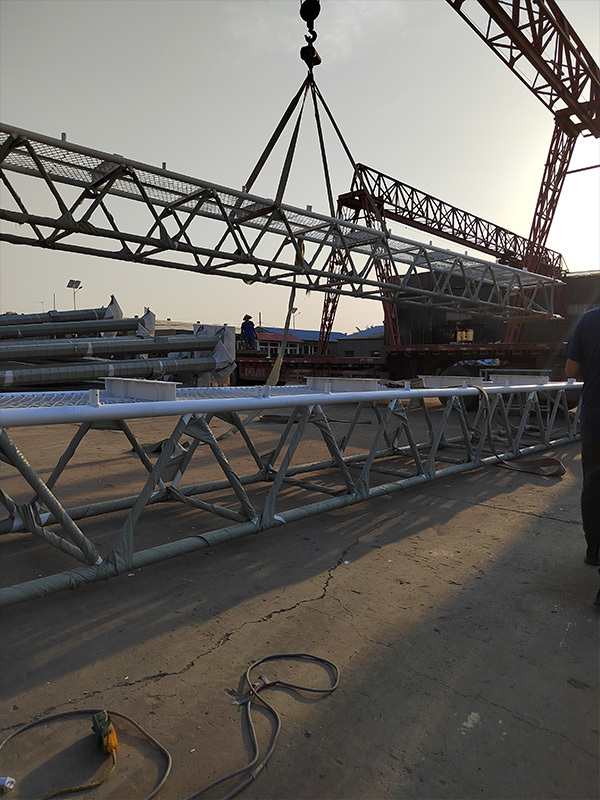
The hoisting and positioning of solar streetlight poles (especially high poles) is a key project in the installation of solar streetlights. The planned pole positions are mostly determined by calculations, but on-site there may be some discrepancies between the actual positions of the solar streetlight poles and the planned ones, requiring adjustments on-site.
Preparation and precautions before installing solar streetlights: The hoisting and positioning of solar streetlight poles (especially high poles) is a key project in the installation of solar streetlights. The planned pole positions are mostly determined by calculations, but on-site there may be some discrepancies between the actual positions of the solar streetlight poles and the planned ones, requiring adjustments on-site. Additionally, it is important to assess whether the construction site is suitable for transportation, whether hoisting vehicles can access the site, whether hoisting equipment can be positioned for work, and whether there are power outages or temporary traffic interruptions. Only through on-site inspections can a feasible hoisting plan be developed.
Except for some key projects, most solar streetlight lighting projects on roads and bridges are completed in a rush during a period before and after the main road construction is finished. However, with the improvement of economic development levels, solar road lighting has become an integral part of beautifying urban landscapes.
Therefore, to ensure the solar streetlight project, suppliers and installers of streetlight fixtures should actively get involved in the solar road lighting project early on. The following points should be noted during the installation of streetlights:
1. Fully understand the characteristics of solar streetlight fixtures, light sources, and poles. Based on practical road conditions and reference lighting standards, combined with investment budgets, reasonably select solar fixtures, light sources, and poles to fully utilize the efficiency and energy-saving capabilities of light sources as well as the advantages of fixture distribution and component combinations.
2. Under the condition of ensuring lighting performance, appropriately increase the spacing between solar streetlight fixtures to save on the number of fixtures; appropriately increase the height of solar streetlight poles to improve lighting effects; if possible, place poles in the middle separation area of roads to save on project costs.
3. In conjunction with road engineering, timely get involved in pole position selection, foundation construction, and embedding to promptly identify issues, make reasonable adjustments, ensure quality, and save on investments.
4. Based on the actual conditions at the solar streetlight construction site and geological conditions, design and manufacture foundations for solar streetlight poles and high poles to ensure that they are solid and reliable. Special attention should be paid to matching embedded bolts with reserved holes in pole bases accurately, ensuring proper positioning, reasonable embedded lengths and external reserved lengths, and properly protecting threaded parts for easy hoisting and positioning.
5. In areas with rock layers or weathered stone where dispersed grounding and segmented grounding are difficult to meet requirements, consider using galvanized flat steel or other conductors for long connections as per design requirements. Connections should be reliable and appropriately protected while being securely connected to embedded foundations to ensure each pole is reliably connected to the ground. High poles in solar streetlights rely mainly on foundation grounding; if necessary, use grounding agents to reduce grounding resistance.
6. Hoisting operations must strictly adhere to operating procedures. Special attention should be paid to power lines around hoisting equipment and other lines as well as surrounding structures; hoisting points should be reasonable, and adjustments should be made promptly after positioning.
7. Pay attention to the aesthetics of solar streetlight poles after installation. From the beginning of foundation construction, control linearity based on main lines while reasonably following road design line changes; ensure that poles are straight, avoid placing weld seams and maintenance openings in main traffic directions while maintaining consistency throughout; maintain harmony in direction and angle for pole cantilevers.
8. Internal components of solar streetlight fixtures must be securely inserted to prevent loosening due to wind sway or poor contact causing failures. Solar streetlight fixtures must be securely fixed to poles, and poles must be securely fixed to cantilevers. Each section of high poles in solar streetlights must be properly fitted together; lifting frames must securely fix fixtures; lifting systems must be safe and reliable with complete functions such as lifting, limit setting, and positioning.
Related News
Jul 22,2024
Jul 02,2024
Jun 22,2024
Jun 12,2024
Jun 02,2024
Contact Information
Tel:+86-371-62650998
Mobile Phone:+86-13623854456 / +86-18637168316
WeChat: ar13623854456
Address: 300 m west of intersection of Beijing-Hong Kong line and G107 in Lihe Town, Xinzheng City, Henan Province


Scan the code