
Henan LED street lights, Zhengzhou sign poles, Zhengzhou solar street lights, octagonal poles
The reason why solar street lights do not light up during continuous rainy days.
Category: Company News
May 07,2022
Solar street lights: As the name suggests, they use solar energy to provide electricity for street lights. During the day, solar street lights use solar panels to convert solar energy into electrical energy, which is stored in batteries through a solar street light controller. At night, the controller manages the power supply from the batteries to the light source. Recently, many regions across the country have experienced continuous rainy weather, which significantly reduces the efficiency of solar energy conversion in solar street lights, sometimes resulting in no energy conversion at all. How can we ensure power supply to the light source during such conditions? What are the main reasons for solar street lights not lighting up during continuous rainy days?
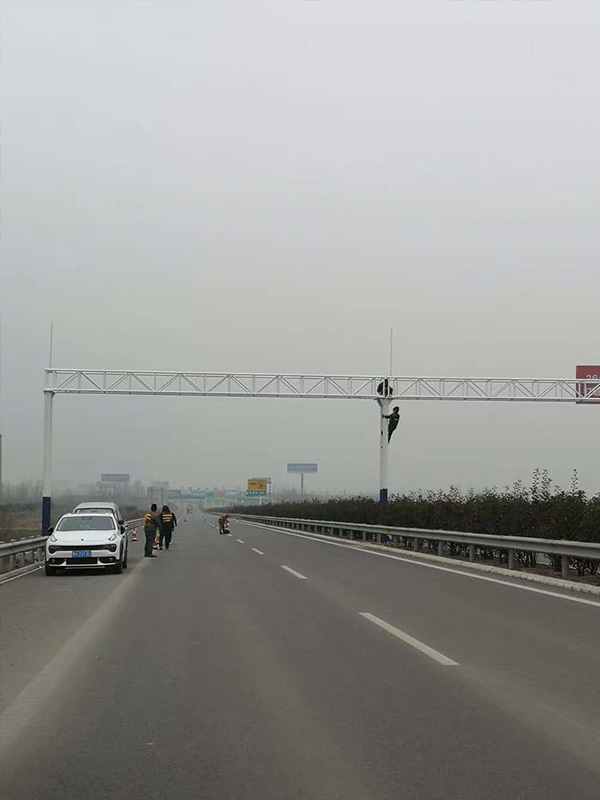
First, when designing solar street lights initially, it is necessary to consider local solar resources and climatic conditions to reasonably configure the solar street light system. Before continuous rainy days arrive, it is essential to design a system where the electrical energy converted by the solar panels and the battery storage capacity can fully meet the power supply needs of the light source during the longest continuous rainy period. In practice, some manufacturers or suppliers fail to configure the solar street light system reasonably based on local characteristics, or due to customers' relentless pursuit of the lowest price, some suppliers have to reduce configurations to close deals. This is one of the reasons why solar street lights sometimes do not light up during continuous rainy days.
Second, the quality of the solar street light lamp head may not meet standards, leading to inadequate waterproofing. If water enters the lamp head, it can damage the light source; additionally, many solar street lights now commonly use LED light sources, which may also have quality issues that result in them not lighting up.
Third, damage to the solar street light controller can occur. Some controllers are not adequately waterproofed and can suffer water ingress during continuous rainy days, leading to damage. The charging and discharging operations of solar street lights rely on the controller; therefore, it is important to choose high-quality controllers that are waterproof.
Fourth, there may be wear and tear on wiring, circuit breaks, short circuits, or poor contact at connection points. These issues are significantly related to construction quality; thus, it is advisable to hire professional personnel for installation.
Fifth, battery damage can occur. If the battery quality is subpar and its capacity decreases over time, it may not hold enough charge; or if waterproofing is inadequate and water enters the battery casing, it can lead to damage.
Related News
Jul 22,2024
Jul 02,2024
Jun 22,2024
Jun 12,2024
Jun 02,2024
Contact Information
Tel:+86-371-62650998
Mobile Phone:+86-13623854456 / +86-18637168316
WeChat: ar13623854456
Address: 300 m west of intersection of Beijing-Hong Kong line and G107 in Lihe Town, Xinzheng City, Henan Province


Scan the code