
Henan LED street lights, Zhengzhou sign poles, Zhengzhou solar street lights, octagonal poles
Advantages of the setup of solar street lights and grid electricity complementary system
Category: Industry News
Jan 04,2022
The design of the solar photovoltaic street light and the complementary lighting system with municipal electricity focuses on technical keys such as the conditions and locations for municipal electricity to cut in, the impact of the cut-in process on different types of light sources, the characteristics of automatic light switching in the complementary lighting system, and daily management issues.
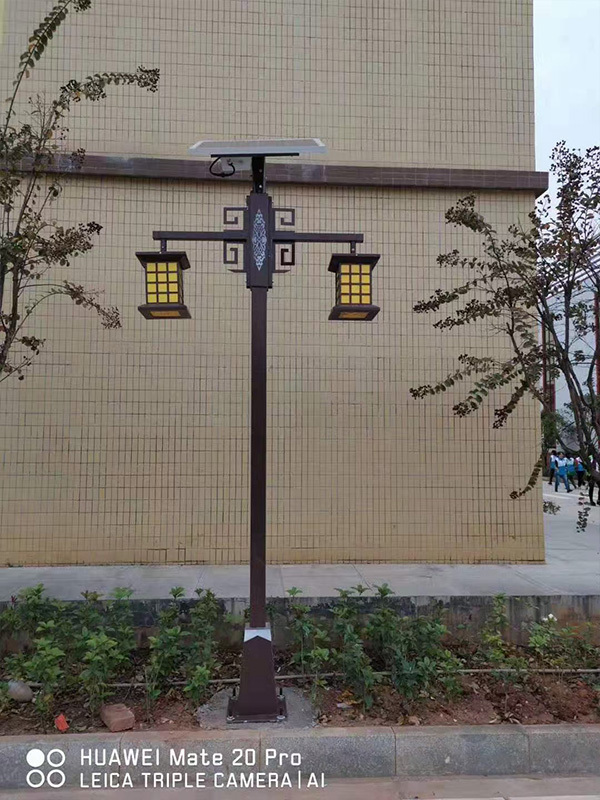
The basis for municipal electricity cut-in in the solar photovoltaic power and municipal electricity complementary lighting system is that municipal electricity can only fully cut in when the energy supplied by the solar cells is insufficient to drive the light source. How to determine that the energy supplied by the solar cells is insufficient to drive the light source is key to this issue.
Testing the terminal voltage of the battery should be the simplest and most effective method. Since the power of the light source is constant, the discharge current of the battery is fundamentally stable, and the situation of the solar photovoltaic system, especially its stored energy size, can be reflected in the terminal voltage of the battery. Therefore, municipal electricity cut-in can be controlled by testing the terminal voltage of the battery. For lead-acid batteries, in a 12V system, it is generally chosen that when the battery voltage drops to 11V, at dawn, the street light switches from solar photovoltaic power to municipal electricity; if it is a 24V system, it switches to municipal electricity when the battery voltage drops to 22V.
Related News
Jul 22,2024
Jul 02,2024
Jun 22,2024
Jun 12,2024
Jun 02,2024
Contact Information
Tel:+86-371-62650998
Mobile Phone:+86-13623854456 / +86-18637168316
WeChat: ar13623854456
Address: 300 m west of intersection of Beijing-Hong Kong line and G107 in Lihe Town, Xinzheng City, Henan Province


Scan the code